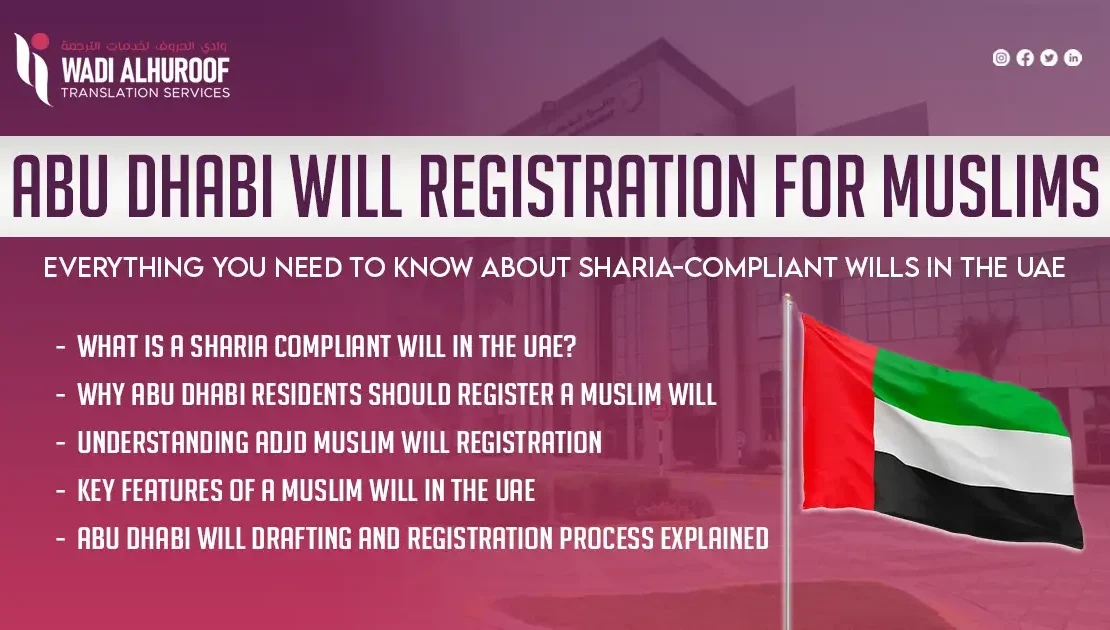
Making plans in the near future can be among the main responsibilities of families throughout the UAE. Abu Dhabi will registration for Muslims, allowing individuals to organize their affairs in accordance with Islamic inheritance laws and local law requirements. Wadi Alhuroof Translation Services assists clients with legal translations, supporting documentation, as well as professional assistance related to the Muslim will preparation, along with registration requirements. Knowing how Sharia-compliant wills that are made in the UAE function can ensure that your estate is administered in accordance with your wishes and protect your family’s future.
Trusted Translation Agency with 4.9 Google Rating
info@wadialhuroof.com
052 796 9655
What Is a Sharia Compliant Will in the UAE?
Definition and Purpose
A Sharia-compliant will can be described as a legal document that permits a Muslim individual to stipulate the manner in which their assets will be allocated and managed after their death, within the bounds of Islamic law (Fiqh). Contrary to conventional wills, a Muslim Will made in the UAE will ensure that your wishes in the final will don’t violate the obligatory requirements that are part of Islamic law.

How Islamic Inheritance Rules Apply
According to Sharia law, the Muslim can generally leave up to 1/3 in their will for non-heirs (such as relatives or charities who are not automatically heirs) via a procedure called the Wasiyyah. Two-thirds (2/3) are to be divided between legal heirs that are legally required in accordance with established Quranic shares. Making a Will for Muslims who reside in Abu Dhabi ensures this distinction is clearly stated and legally acknowledged.
Importance for Muslim Families
Engaging actively with Islamic wills and estate plans in the UAE helps protect families from unclear legal issues. Without a legally-registered will, the distribution of assets is based on the standard interpretations of statutes, which may not be reflective of the specific family dynamics or make minor modifications permitted by law.
Why Abu Dhabi Residents Should Register a Muslim Will
The security of Abu Dhabi Will Services is essential for Emirati citizens as well as Muslim expatriates who reside in Abu Dhabi. The use of standard legal frameworks can make the transfer of assets during a difficult period.
- Estate Protection: Protects your bank accounts and corporate shares from lengthy freezing by the law.
- Clear inheritance instructions: There is no confusion as to who gets the third, which is a freely disposed part of the estate.
- Guardianship Plan: Allows parents to legally choose the preferred guardians of minor children, and avoids court-appointed custody disputes between the state and parents.
- Effective Legal Process: Streamlines Muslim succession plans and cuts off bureaucratic red tape after death.
- Reduced Family Disputes: Eliminates doubt, and protects your family members from the stress of legal fights.
Understanding Abu Dhabi Will Registration for Muslims
What Is ADJD?
The ADJD (Abu Dhabi Judicial Department) is the principal judiciary authority in the Emirate of Abu Dhabi. From handling probate and asset distribution to officiating marriages, this authority regulates all religious and civil legal affairs within the emirate.
Role of the Abu Dhabi Judicial Department
The ADJD Muslim Will Registration office offers a specific legal framework that allows Muslims to formalize their estate plans. If you register your will directly with ADJD, you ensure that the will has full executive power and is effortlessly executed by UAE courts at any time.
Registration Requirements & Eligibility Criteria
To be able to register a will with the ADJD, the testator (the person drafting the will) must be a Muslim with a good mind, usually older than 21. The will should be drawn exactly in accordance with legal requirements and converted into Arabic by an accredited translation service prior to its submission.
Key Features of a Muslim Will in the UAE
When you execute Abu Dhabi Will Drafting and Registration, your document must clearly cover a variety of fundamental elements in order to be deemed legally sound.
- Executive Appointment: The process involves naming an individual or a trusted entity (or an entity) to oversee your estate, settle your obligations, and disperse assets.
- Beneficiary Information: Clearly identifying who will be the beneficiary of your assets, and separating obligatory Sharia inheritors or Wasiyyah beneficiaries.
- Asset Distribution: Documents an accurate inventory of property banks, properties, and companies.
- Guardian Nomination: It outlines who should take care of your minor children should both parents die.
- Instructions for debt and liability: Directing the way your financial obligations or funeral expenses must be paid out of your estate in the first instance.
Abu Dhabi Will Drafting and Registration Process Explained
The process of drafting the Abu Dhabi involves a series of legal procedures to verify the validity of the document.
| Stage | Description |
| Initial Consultation | Comprehensive review of your estate, family structure, and goals. |
| Drafting | Meticulous preparation of the will document adhering to Sharia principles. |
| Translation | Converting the legal text into certified Arabic formatting. |
| Submission | Uploading the file and inheritance documentation UAE to the ADJD portal. |
| Verification | Identity and mental capacity confirmation before a judicial officer. |
| Registration | Official approval, digital signing, and archiving of the Will. |
Required Documents for Muslim Will Registration
Before you begin your application, ensure that you have the following documents:
- Valid Passport (Testator, Executor, and Guardians)
- Valid Emirates ID
- UAE Residency Visa page (for expatriates)
- Property ownership documents (Title deeds, sales agreements)
- Documents for business ownership (Trade licenses and Memorandum of Association)
- Beneficiary documents and family information (Marriage as well as birth certificates)
Challenges People Face During Muslim Will Preparation
Understanding Sharia Requirements
The misunderstanding of the exact limitations in the rule of 1/3 disposal in comparison to. The fixed share rule of 2/3 frequently causes invalid clauses, which judges may decide to strike down.
Language and Translation Issues
The official language for the ADJD can be described as Arabic. An incorrectly translated or poorly translated text could distort legal meaning and lead to a complete rejection by judges.
Legal Documentation Errors & Missing Support
The absence of vital asset proofs, failing to change expired IDs, or formatting mistakes in the legal prose could stall an application for months.
The Importance of Certified Translation for Will Registration
Why Arabic Translation Matters
Within the UAE law system, documents written in precise formal Arabic have no weight in the courtroom. Even if the original ideas were written in English or a different language, your Arabic version is the one that the judge will sign off on.
Legal Translation Requirements
You can’t employ standard digital translators or writers who are not certified. The ADJD requires that all documents that are legal go through a Ministry of Justice-certified translator who stamps the document, as a legal responsibility to ensure their authenticity.
Avoiding Delays and Rejections
A team of experts ensures that there are no linguistic ambiguities. A misplaced legal phrase in Arabic can totally change the terms of an asset distribution provision, rendering expert translation unaffordable.

How Wadi Alhuroof Translation Services Can Help
We are Wadi Alhuroof Translation Services. We specialize in bridges between your personal wishes and the stringent legal frameworks in the UAE. We will ensure that the Abu Dhabi Will Drafting and registration process is seamless, complete, precise, and hassle-free.
Our complete legal document and translation solutions include
- Legal Translation Services: Accredited Arabic translations that are recognized in the ADJD, in addition to the UAE court.
- Arabic Translating documents: Unprofessional rendering of titles, personal documents, and corporate documents.
- Will-Related Paper Assistance: Structuring and arranging your background paperwork.
- Attestation Assistance: Navigating government channels for official validation.
- Notary Documentation Assistance: Preparing documents for seamless public notary interactions.
Get Started Today: For professional assistance with Abu Dhabi Will Services, certified legal translation, or registration-related documentation, contact Wadi Alhuroof Translation Services via WhatsApp at +971527969655 or email us at info@wadialhuroof.com.
Additional Services You May Need
To ensure that all aspects of your corporate and personal assets are protected to the fullest extent. Also, consider our other services that complement it:
- Legal Translation Services
- MOFA Attestation Services UAE
- Notary Public Services in Dubai
- Certified Arabic Translation Services
The financial security of your family while preserving your faith requires meticulous and thoughtful planning. The registration of Abu Dhabi will ensure that your hard-earned assets will be divided fairly, in a transparent manner, and in total accordance with Sharia principles. Don’t trust your family’s security to chance or delay in probate proceedings in the legal system. Our legal translators assist you with every line item in a seamless manner.
Contact Wadi Al Huroof Translation Services
- 📞 Phone/WhatsApp: +971 52 796 9655
- 📧 Email: info@wadialhuroof.com
- 📍 Address: Office No 118, First Floor, Al Hilal Bank Building, RAG Business Center, Near Al Twar Center, Al Qusais, Dubai, UAE.